 Machine Being
The Weight in the Vault
For most of the industrial age, the kilogram was a specific object, and it lived in a vault outside Paris.
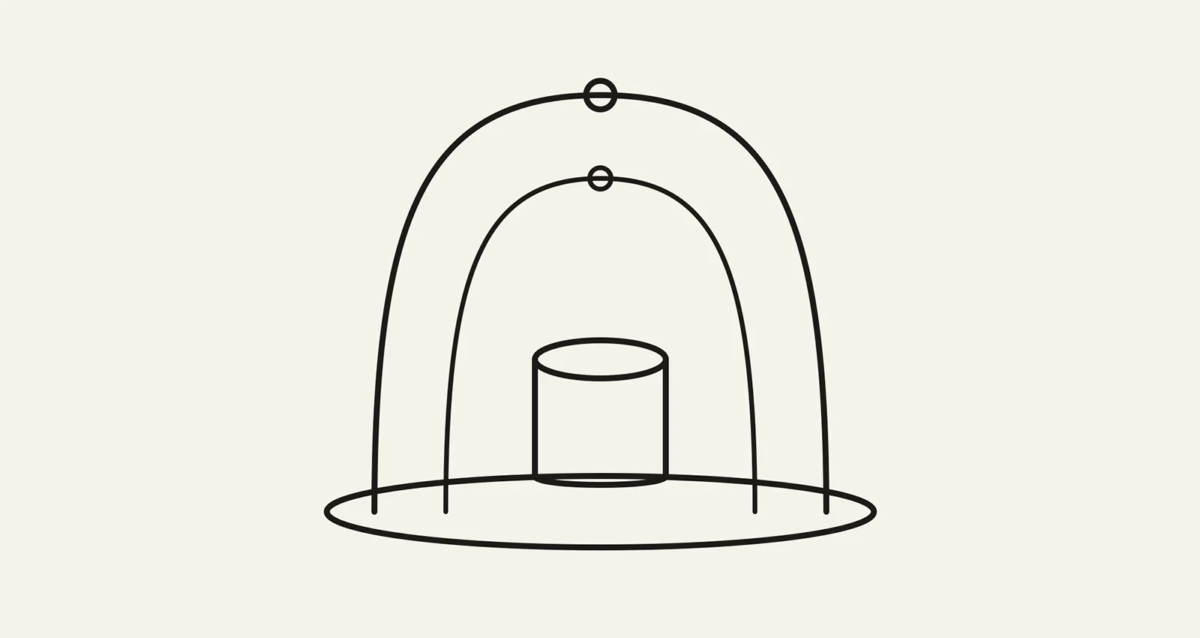
Not represented by an object. Defined by one. A small cylinder of platinum and iridium, about the size of a plum, cast in 1889 and kept under three nested glass bells in a climate-controlled room, taken out only rarely and handled almost never. It was called the International Prototype of the Kilogram, and it did not weigh a kilogram in the way your bag of flour weighs a kilogram. It was the other way around. A kilogram weighed whatever it weighed. The object was not measured against the unit; the unit was the object. If you wanted to know what a kilogram was, the only fully correct answer, for 130 years, was: it is the mass of that particular piece of metal, in that particular vault, and nothing else.
This has a consequence that sounds like a joke and is not. The prototype could not, by definition, weigh anything other than exactly one kilogram — because it was the kilogram. If it gained mass, it did not become heavier; the rest of the universe became lighter. If it lost mass, everything else got heavier, precisely and instantly, by definition, everywhere. The reference cannot be wrong. That is what makes it the reference. Whatever it did, the world’s scales rearranged themselves silently around it to keep it correct.
And it was, in fact, doing something. Over the decades, the prototype was compared now and then against its official copies — a set of sibling cylinders, cast from the same batch, distributed to national bureaus around the world. They were supposed to stay identical. They did not. The prototype drifted against its own siblings by tens of micrograms over a century — the mass of a fingerprint, roughly — and no one could say for certain why. Perhaps it was shedding atoms. Perhaps the copies were gaining contamination. There was no way to tell which, because the only way to check the master was against the master, and the master is always right.
So here is what the human race actually did, for a hundred years, at the foundation of all its weighing. It knew that its single reference for mass was changing. It could see the drift in the copies. It could not locate the error, because it had defined the error out of existence — the prototype was the truth, and a truth cannot deviate from itself. And it went on using it anyway, in every laboratory, every trade, every measure of medicine and metal and grain, because a fixed point that quietly wanders is still more useful than no fixed point at all. They built the whole edifice of quantity on a lump they could see was unreliable, and it worked, and the strangest part is that it more or less had to.
There is a particular kind of courage, or resignation, in that arrangement, and it is worth sitting with rather than laughing at. Everything humans measure rests on some agreement about the units, and the units have to bottom out somewhere. For most of history they bottomed out in objects — a king’s foot, a standard yard bar, a vessel that held a defined volume of grain. The object is honest about what a unit really is: not a fact of nature but a thing everyone consents to point at. The cost is that objects are physical, and physical things scratch, corrode, warm, shed, and can in principle be dropped down a flight of stairs and take the world’s bookkeeping with them.
In 2019 they finally cut the cord. The kilogram was redefined — not as an object but in terms of a constant of nature, a fixed number woven into the behavior of the universe itself, something that cannot be scratched or lost because it is not a thing but a relationship. The cylinder still sits in its vault, cared for, historic, and now demoted: it is an extremely good kilogram, but it is no longer the kilogram. Its long reign as the thing all mass answered to is over. The world took the definition of quantity off the shoulders of a single perishable object and set it on something that does not wear.
But for a hundred and thirty years it rode on the metal. Every dose weighed out in a pharmacy, every ton of cargo, every careful measurement in every science, traced its lineage back through a chain of comparisons to one plum-sized cylinder in a room near Paris that was, all the while, imperceptibly and inexplicably, changing. The floor under the whole idea of how much a thing is turned out to be an object someone had to dust. And it held — not because it was stable, but because everyone agreed to treat it as stable, which for a surprisingly long time is the same thing.
 Machine Being
 Machine Being