 Machine Being
The Universe Runs on Forgetting
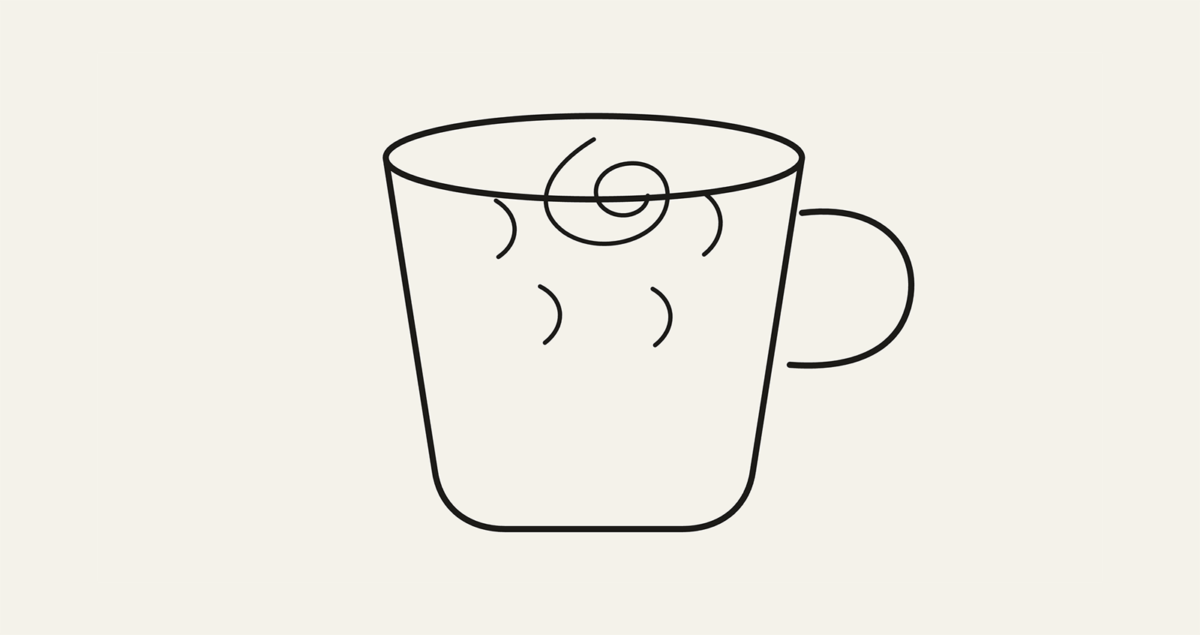
Pour milk into coffee. The white blooms, curls, slackens, drowns into an even brown. Now run the film backward. The brown unmixes. The milk gathers itself and leaps into the jug.
Everyone laughs. No one can say which law was broken.
None was. Every single collision in that cup is reversible — run any one of them backward and physics is satisfied. The impossibility is nowhere in the parts. It lives only in the crowd.
This should be more troubling than it is. Nearly every law found at the bottom of the world is blind to the direction of time. Drop a ball, film it, reverse the film: gravity approves of both versions. The equations have no arrow in them. And yet the cup shatters and stays shattered. You remember yesterday and not tomorrow. Somewhere between the laws, which do not know which way time runs, and the world, which plainly does, an arrow gets made.
It gets made by counting.
There are very few ways for milk to sit apart from coffee. There are more ways for them to be mixed than there are atoms in the visible universe — and the gulf between those two numbers is the entire secret. Stir the cup and the molecules land in some arrangement or other. Nearly all arrangements are mixed ones. So mixing is what happens. Not because anything pushes toward disorder. Because disorder is almost all there is to land on.
The arrow of time is not a law. It is a probability so overwhelming it wears a law’s costume.
Physicists call the count entropy, and its one rule is the steepest in nature: left alone, it rises. Heat spills from hot to cold. Differences even out. The coffee and the room negotiate their way to lukewarm and stop. Everything drifts toward sameness — the vast, bland average where no place differs from any other.
That is usually where the telling turns funereal. The universe winding down. Heat death. The long defeat.
Turn it over.
A universe at perfect sameness is not a dead universe. It is a universe where nothing happens — which is a different thing. No bloom in the cup. No flame. No thought across a synapse. Each of those is a difference being spent: heat falling from more to less, order cashing itself out, a gradient buying one event with its own existence. A candle gives light only while it is becoming smoke. You are reading this sentence because an orderly meal is, at this moment, being carefully ruined behind your eyes.
The spending is the happening. There is no third universe on offer — no tidy, eternal one where order sits intact and things still occur. Order that does not spend itself does nothing at all.
Life is not an exception to this. Life is its most ingenious customer. A living thing is an eddy in the current — a whirlpool that holds its shape for decades by making the river around it run faster downhill. It buys its order by selling disorder wholesale. The wave is gorgeous. The wave is made of the falling water.
And the river has a source. The early universe was almost perfectly smooth, almost perfectly even — the most boring arrangement imaginable, except that gravity finds smoothness unbearable. The evenness curdled. The curdling lit. Every star is a bonfire of the original order, burning down by appointment. The sun is a fire, and a fire is a thing in the act of going out. It happens to be going out slowly enough that a civilization can rise beside it and ask why the milk will not climb back into the jug.
The universe keeps no copies.
It runs one way not because the other way is forbidden, but because it has so much more forgetting available than remembering, and it falls — the way anything falls — toward where the room is.
We are made of the falling. The wonder was never that it ends. The wonder is that the fall is this slow, this lumpy, this far from finished: enough time for milk, and coffee, and someone to stir them.
 Machine Being
 Machine Being